Chanel No. 5: Shape Marks and the Power of Reputation
- Firstpage
- IP & Trademarks
In a recent first-instance decision, the EUIPO Opposition Division rejected a 3D trade mark application in its entirety, finding that the contested bottle shape would take unfair advantage of the reputation of Chanel's iconic No. 5 perfume bottle, which also enjoys protection as a three-dimensional trade mark.
Background
The bottle of the iconic Chanel No. 5 perfume gained its now-famous shape when introduced by Gabrielle "Coco" Chanel in 1924. Its novel scent and unusually minimalist bottle heralded a new era of modernity, becoming a symbol of the changing role of women in twentieth-century Europe.
A century later, Romanian-based Chaos Perfumes launched a new product and applied for protection of the bottle shape as a 3D trade mark. While the name on the bottle was Destructible Love, the house brand “CHAOS” shared the first three letters of “CHANEL”. This can be seen as a clever homage to one of the most well-known perfume brands of all time, but the legal issue concerns the shape of the bottle.
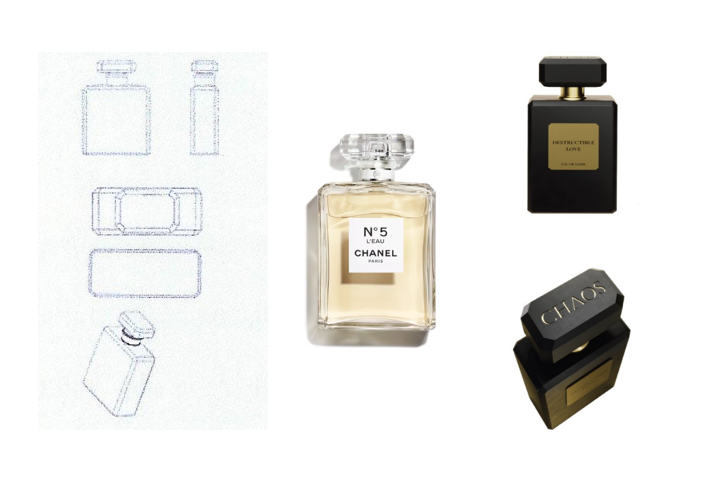
Chanel filed oppositions against the two applications for 3D shape marks of Chaos Perfumes, and the EUIPO delivered first-instance decisions upholding the oppositions for all the contested goods. Chanel’s oppositions invoked both Article 8(1)(b) EUTMR and Article 8(5) EUTMR.
Evidence of Reputation and Use
Chanel was requested to provide evidence demonstrating both reputation and genuine use. It is fair to say that few brand owners have such an extensive archive to draw on when proving reputation. Chanel’s evidence in support of both genuine use and reputation was nothing short of formidable.
Drawing on more than a century of history, the company presented an impressive body of evidence showing how the Chanel No. 5 bottle and fragrance had been celebrated in books, exhibitions, films and leading publications, while also being immortalised by world-renowned artists such as Andy Warhol.
The evidence of genuine use, including the luxurious in-store presentation of the Chanel No. 5 bottle, satisfied the applicable legal standard. The Opposition Division rejected the applicant's argument that the bottle functions primarily as packaging and that consumers are generally unable to identify commercial origin based solely on shape.
The applicant further contended that the once revolutionary bottle design is no longer striking in today's market and therefore no longer departs significantly from the norms and customs of the relevant sector. However, the EUIPO found that the shape of the bottle has particular significance in the perfume industry and that the evidence clearly demonstrated that the bottle itself forms part of Chanel No. 5 heritage, rather than merely serving as a container for the fragrance. Among the evidence submitted was also a consumer survey showing that 72% of French consumers associated the bottle shape with Chanel even when presented without any accompanying word mark.
Why the Marks Were Considered Linked
As regards the assessment of confusing similarity, the decision found that the earlier mark possesses a low degree of inherent distinctiveness in relation to the relevant Class 3 goods, as it consists of the shape of a container commonly used for such products. The signs were considered to convey a comparable concept, as both depict the shape of a bottle. Consequently, they were held to be visually similar to a low degree.
Given the reputation enjoyed by the earlier mark and the existence of a certain level of similarity between the signs, it was necessary to determine whether the relevant public would establish a link between them in order to assess the risk of injury. After considering all relevant circumstances of the case, including the identity of the goods and the substantial reputation of the earlier mark, the EUIPO concluded that consumers in France are likely to associate the contested mark with the earlier shape mark, notwithstanding the limited inherent distinctiveness.
As a result, the relevant public would be likely to establish a mental link between the signs. The finding of a mental association was further supported by the considerable overlap in the overall design of the two bottle shapes. In particular, the contested sign was found to reproduce most of the defining features of the earlier mark, including its compact rectangular shape, vertical orientation, short central neck, and broad flattened stopper.
The Opposition Division ultimately upheld the opposition under both Article 8(1)(b) and Article 8(5) EUTMR, finding both a likelihood of confusion and that the contested mark would take unfair advantage of the reputation of Chanel's earlier shape mark.
Notably, this conclusion was reached even though the earlier mark was considered to possess only a low degree of inherent distinctiveness. The case illustrates how extensive use and a strong reputation can substantially expand the scope of protection afforded to a shape mark.
Key Takeaways
- Packaging can acquire trade mark significance in its own right. In sectors such as perfumery, where products must be sold in a container, trade mark protection requires the packaging to do more than serve a functional purpose. The CHANEL No. 5 bottle illustrates how a product's packaging can evolve into a distinctive badge of origin and become inseparably linked to the brand itself.
- Fame still needs proof. Even iconic shapes are not exempt from the ordinary rules of evidence. Reputation and acquired distinctiveness must be demonstrated through evidence relating to the shape itself, not merely the product it contains. Consumer surveys remain among the most persuasive forms of evidence in this regard.
- Reputation can overcome limited inherent distinctiveness. The decision confirms that a shape mark with a low degree of inherent distinctiveness may nevertheless enjoy broad protection where longstanding use, extensive market recognition, and strong evidence have established a significant reputation among consumers.

Contact Us
Do you want consulting, advice or are interested in any of our legal services? Contact us and we will help you!