


The Price of Fame: When Does a Well-Known Name Stop Functioning as a Trade Mark?
- Firstpage
- Legal Case Files

The EUIPO draws a line in “ORWELL"
Can the name of a renowned author function as a trade mark for books, films and related cultural activities, entertainment and educational services? Or does widespread cultural recognition strip it of its ability to indicate commercial origin?
The registrability of famous authors’ names has long posed a tricky question within EU trade mark law. While personal names constitute, in principle, registrable signs, cultural fame has in some EUIPO decisions been treated as eroding a name’s ability to function as a delineator of origin, particularly where the relevant public is likely to understand the name as denoting the subject matter of the goods or services concerned.
This tension lay at the core of the EUIPO Grand Board of Appeal’s decision of 19 December 2025 in The Estate of the late Sonia Brownell Orwell v EUIPO (Case R 2248/2019-G), regarding the registrability of the word mark GEORGE ORWELL. The decision is notable not because it introduces a new exclusion for famous names. Rather, it clarifies the circumstances in which cultural fame may lead a personal name to be perceived as descriptive of content, rather than as a badge of trade origin.
Background: The Application, Partial Refusal and Appeal
In 2018, the estate of Orwell’s second wife, Sonia Orwell, applied to register GEORGE ORWELL as an EU trade mark for a range of goods and services in classes 9, 16, 28, and 41, including recorded media, printed matter, and entertainment, cultural and educational services.
In 2019, the examiner partially refused the application under Articles 7(1)(b) and 7(1)(c) EUTMR, finding that the relevant public would perceive the sign as referring to the famous writer and, therefore, as describing the subject matter of the goods/services – namely, that they were by or concerning George Orwell. That refusal was upheld on appeal.
However, given diverging EUIPO decisions in earlier cases involving famous names used for goods/services whose essential characteristic is their content, the Fifth Board referred the matter to the Grand Board.
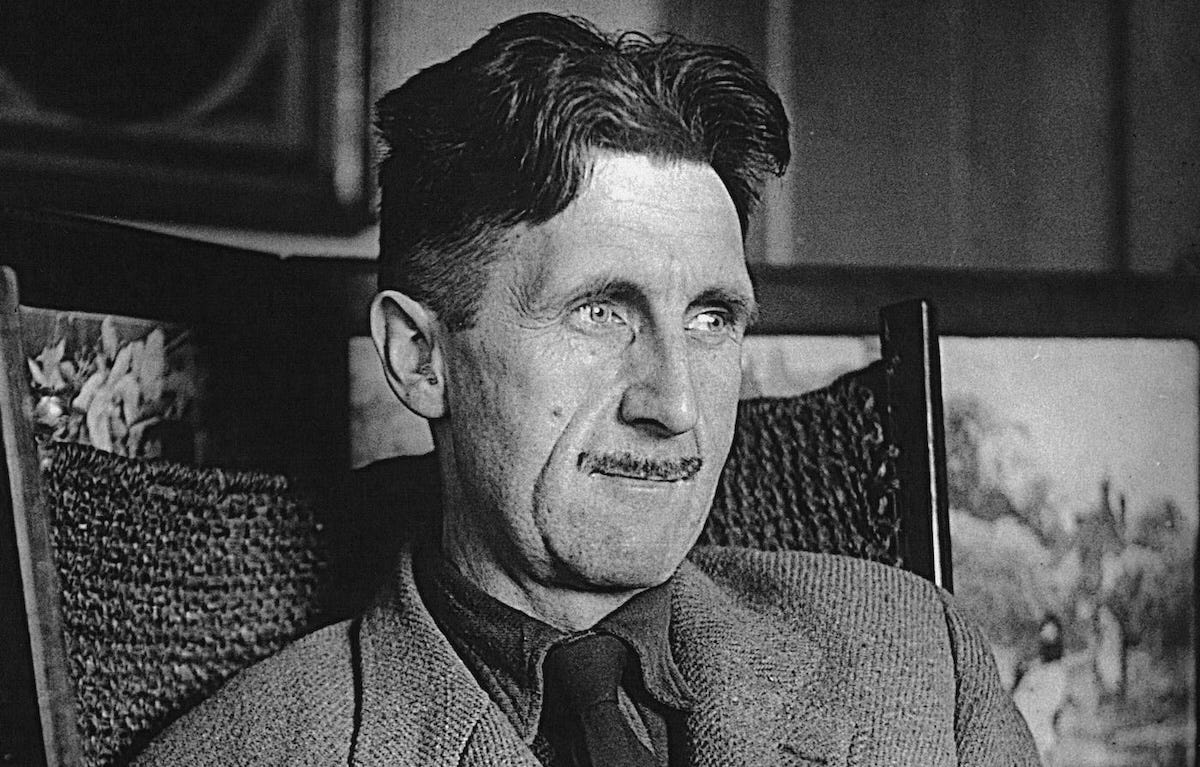
George Orwell
Subject Matter as a Form of Descriptiveness
The Grand Board’s reasoning under Article 7(1)(c) turned on how the term “other characteristics” should be understood in the exclusion from registration of signs designating an objective property of the relevant goods or services. The Board confirmed that this ground of refusal applies only to characteristics that are inherent to the nature of the relevant goods/services and “easily recognisable by the relevant class of persons” (para 31).
The Board held that “other characteristics” “can be understood to include, inter alia, the subject matter/content of the goods or services in question” (para 68). While “subject matter” is not defined in the EUTMR or the Trade Mark Directive, the Board noted that it is a recognised concept in Article 7(1)(c) analysis, operating as a “subcategory of the absolute grounds of refusal based on descriptiveness” for marks consisting “exclusively of terms describing the thematic or intellectual content of the goods or services”(para 69).
The Board was careful to draw limits around this concept. A ‘subject-matter’ objection, it stressed, “can in principle only be applied” to those goods/services containing “information about other matters or refer[ring] to them, such as[…] books, magazines or training services” (para 70). In such cases, the operative question is whether the relevant public would perceive the sign as indicating what the goods/services are about, rather than their commercial origin.
No Special Treatment for Famous Names
Properly understood, the Grand Board’s analysis does not create a special category of refusal for famous names, but applies orthodox Article 7(1)(c) principles to content-oriented goods/services. Indeed, the Board confirmed that marks consisting of authors’ names are “not subject to any ‘special treatment’ during their examination” and may be distinctive – including for books – pursuant to Article (1)(b) EUTMR provided “they are capable of identifying the commercial origin of those goods” (para 130). Distinctiveness must therefore be assessed on the mark’s own merits, by reference to the relevant consumer’s perception and the sign’s ability to indicate commercial origin.
Assessing Consumer Perception and Applying it to GEORGE ORWELL
Turning then to its assessment of how the relevant public would understand the sign GEORGE ORWELL in relation to the applied-for goods/services, the Grand Board identified a number of “non-exhaustive and non-cumulative criteria” relevant to assessing whether an author’s name will be perceived as descriptive of subject matter, including: the degree of recognition of the author; the dissemination and longevity of their works; social and cultural integration; linguistic evidence, including the emergence of derived adjectives; and market realities, including how works are presented or categorised (para 78).
Applying this framework, and taking account of Orwell’s exceptional cultural prominence, the enduring relevance of his works, their widespread inclusion in education, and the use of the adjective ‘Orwellian’ in everyday parlance, the Grand Board found that GEORGE ORWELL would be “immediately and unequivocally understood as referring to that well-known British writer”. Consequently, the relevant public would, “without further mental effort”, perceive that the goods/services in question “concern the author George Orwell, his writings or the ideas and themes deriving from them as their subject matter” (para 101).
The Board endorsed the reasoning applied in SIBELIUS (15/05/2018, R 2382/2017-2), where the refusal of the sign was upheld in relation to, inter alia, musical recordings, printed matter and entertainment services on the basis that the relevant public’s perception of the sign would be that it “merely indicates a descriptive link with their subject matter, namely the music, life or person of Jean Sibelius”. The Board therefore concluded that GEORGE ORWELL was descriptive for all the goods and services at issue.
Distinctiveness and Territorial Scope

Having found the mark descriptive under Article 7(1)(c), the Grand Board noted it was not strictly necessary to examine Article 7(1)(b). Nonetheless, it confirmed that GEORGE ORWELL was also “non-distinctive[…] because it consists of the name of the famous British author George Orwell”, and merely indicated a link with his work, life or personality (para 134).
Regarding territorial scope, the Board confirmed that refusal is justified where the absolute grounds apply in part of the European Union only. Given Orwell’s position in English-language literature and education, the perception of English-speaking consumers, including Irish and Maltese consumers, was sufficient to sustain refusal under Article 7(2) EUTMR
Key Takeaways
1. Filing strategy for famous names
The scope for securing EU trade mark protection for famous names in relation to books, films, documentaries and cultural/entertainment/educational services has narrowed. Where a name is likely to be understood as pointing to subject matter rather than commercial origin, registration will be difficult to secure for core cultural content. Brand owners should therefore be mindful that while fame may enhance reputation, it can also narrow the scope of registrable and enforceable trade mark rights.
Where trade mark protection remains commercially important, applicants should instead consider filing a composite or stylised mark, or seeking protection for non-subject-matter-oriented goods/services.
2. Descriptive use is safe, implied endorsement or association less so
Using an author’s name descriptively to identify subject matter, e.g., “The complete works of George Orwell” or “a documentary about Orwell”, remains non-infringing use. Risk arises where the presentation of goods/services implies an endorsed connection with an estate where none exists.
3. Trade mark law is not a proxy for copyright or moral rights
This decision underlines that registrability under Article 7 EUTMR turns on trade mark function alone. Questions of copyright ownership, moral rights or cultural stewardship, however legitimate, do not alter the assessment of whether a sign will be perceived as indicating commercial origin. Trade mark law will not fill perceived gaps in other regimes.
The Grand Board has not closed the door on famous names. It has, however, made clear that EU trade mark law will not confer monopoly rights in instances where the public will likely understand a name as referring purely to the subject matter of works, not commercial origin. To borrow a well-worn axiom, fame sometimes comes at a price.

Contact us
Do you want consulting, advice or are interested in any of our legal services? Contact us and we will help you!