


No Stripes Earned by Adidas
- Legal Case Files

In the long-running battle between Thom Browne and Adidas, the UK Court of Appeal (Thom Browne Inc and Thom Browne UK Limited v Adidas AG [2025] EWCA Civ 1340), found in favour of Thom Browne and upheld the High Court decision.
Background
Thom Browne applied to the High Court for declarations of invalidity (and alternatively, revocation) of 16 trade mark registrations owned by Adidas, which comprised three stripes on various items of clothing, footwear, headgear and bags.
Thom Browne took a three-pronged attack on the grounds of (1) lack of registrability within the meaning of Section 1(1), (2) lack of distinctive character, and (3) lack of genuine use. The High Court judge found that the first prong had succeeded in relation to eight of the marks, but failed in relation to the other eight.

The second prong failed for all sixteen marks, while the third also failed for the most part. Adidas filed a counterclaim for trade mark infringement and passing off, but this was dismissed.
Grounds of Appeal
The scope of the appeal was limited to six ‘position’ trade marks in Class 25, which were held to be invalid due to lack of registrability.
These six registrations essentially comprise three ‘sets’ of trade marks (each consisting of one ‘cloned’ registration and one ‘original’ UK registration), covering largely the same specifications and written descriptions.
Registration No’s
Pictorial Representation
Written Description
00002327095 / 00903517588
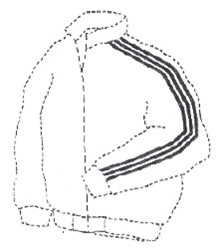
The mark consists of three parallel equally spaced stripes applied to an upper garment, (as illustrated below,) the stripes running along one third or more of the sleeve of the garment.
00002327093 / 00903517661
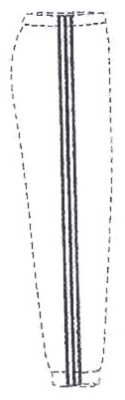
The mark consists of three parallel equally spaced stripes applied to a trouser or short, (as illustrated below,) the stripes running along one third or more of the side of the trouser or short.
00002327092 / 00903517612
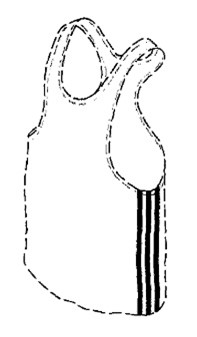
The mark consists of three parallel equally spaced stripes applied to a garment, (as illustrated below,) the stripes running along one third or more of the side of the garment.
The grounds of the appeal were as follows:
1. “The judge wrongly interpreted Dyson as authority for the proposition that the fact that the written description of a mark allows for “unrepresented signs”, and that the pictorial depiction is only an example of the mark, is fatal to registrability, or a factor against registrability.
2. The judge wrongly interpreted the trade marks which led her to overstate the degree of variation encompassed by each mark.
3. The judge wrongly interpreted the trade marks which led her to overstate the degree of variation encompassed by each mark.
4. In her assessment of the degree of variation encompassed by the Trade Marks, the judge wrongly focused on visual differences and omitted to consider properly the impact on the origin message.”
Decision
None of the grounds was accepted by the Court of Appeal.The decision centered on two key questions:
- Whether the subject-matter of each registration is a sign, and if so,
- Whether the graphical representation (both the pictorial representation and the written description) meets the requirements of clarity and precision.
The Court confirmed that:
- The fact that a mark may include possible variations does not automatically invalidate it.
- However, validity always depends on the specific facts and the nature of the mark, including the extent to which variations might be permitted.
In this case, the High Court judge held, and the Court of Appeal agreed, that:
- Although the pictorial representations were not inconsistent with the written descriptions. The phrasing of the written descriptions gave rise to several different possibilities of the mark.
- This meant the pictorial representations were only examples, not definitive depictions, of what the written descriptions could cover.
More specifically:
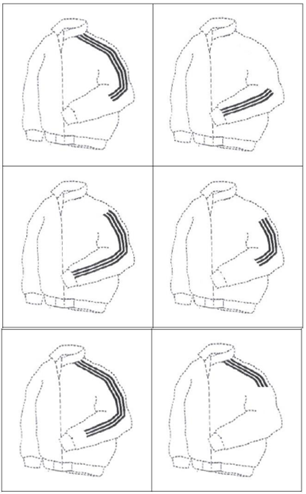
- The written descriptions referred to stripes “running along one third or more” of the sleeve/side of the trousers or shorts/side of the garment. While clear in wording, this phrasing allowed for numerous unrepresented signs in practice.
- The EUIPO Cancellation Division’s decision illustrated examples of these variations (Track Suit Top Marks).
- The descriptions could also be interpreted to place the stripes on different parts of the garment, such as the underside of the sleeve.
As a result:
- All six marks failed on both conditions.
- In each instance, the registration did not consist of a single sign, and
- It was not represented clearly and precisely.
Implications for Trade Mark Owners
Faced with the public interest in ensuring that competent authorities and competitors can determine the scope of protection afforded to trade mark owners, it is fair to say that the courts prefer to take a strict approach in relation to Section 1(1) of the Trade Marks Act 1994.
As such, clarity and precision are the name of the game. For trade mark owners, it is therefore crucial to ensure that:
1. the pictorial representation corresponds with the written description;
2. the written description does not go broader than the pictorial representation or give rise to other possible interpretations (particularly if they depart substantially from the pictorial representation);
3. the written description does not include vague and ambiguous wording, for instance, the stripes “running along one third or more” of the sleeve, or a colour “being the predominant colour applied to the whole visible surface of the packaging”.


Contact us
Do you want consulting, advice or are interested in any of our legal services? Contact us and we will help you!